Countertop Branding: The Last 60 Seconds That Can Influence a Tyre Purchase
The final decision in a tyre purchase often happens at the counter, in a short conversation between customer and dealer. Countertop branding gives that moment structure. This article explains what to place on the counter, how to keep it useful, and how manufacturers can roll it out across dealers.
Why the counter matters so much
A customer may notice a fascia from the road, browse a product wall and wait in a lounge, but the final decision in a tyre purchase very often happens at the counter. This is where the dealer quotes a price, the customer asks whether a cheaper option will do, and a choice is made, often within a minute or two.
For a tyre manufacturer, this short window is valuable and fragile. If the counter is cluttered with unrelated calendars, stickers and paperwork, there is nothing to support the brand's message at the moment it matters most. Countertop branding gives that moment some structure, helping the dealer explain options clearly and helping the customer feel confident in the choice.
What happens in the last 60 seconds
Think about the typical final exchange. The customer has a size in mind and perhaps a budget. The dealer suggests one or two options. The customer asks what the difference is. At this point, the dealer needs a quick, believable way to explain why one tyre costs more and what the customer gets for it.
Without visual support, the explanation relies entirely on the dealer's memory and persuasion. With a simple comparison card, a sample section or a short visual guide on the counter, the conversation becomes easier and more consistent. The customer can see and touch something, which tends to make the explanation more credible.
Essential countertop elements
Counter space is limited, so every element should earn its place. A small, well-chosen set of items works better than a crowded counter. The following elements are commonly useful in tyre outlets.
- Comparison card holder: good, better, best options in a simple format
- Tread or cross-section sample: a tactile way to show construction or pattern
- QR standee: links to product pages, warranty information or reviews
- Offer or scheme display: a replaceable insert for current promotions
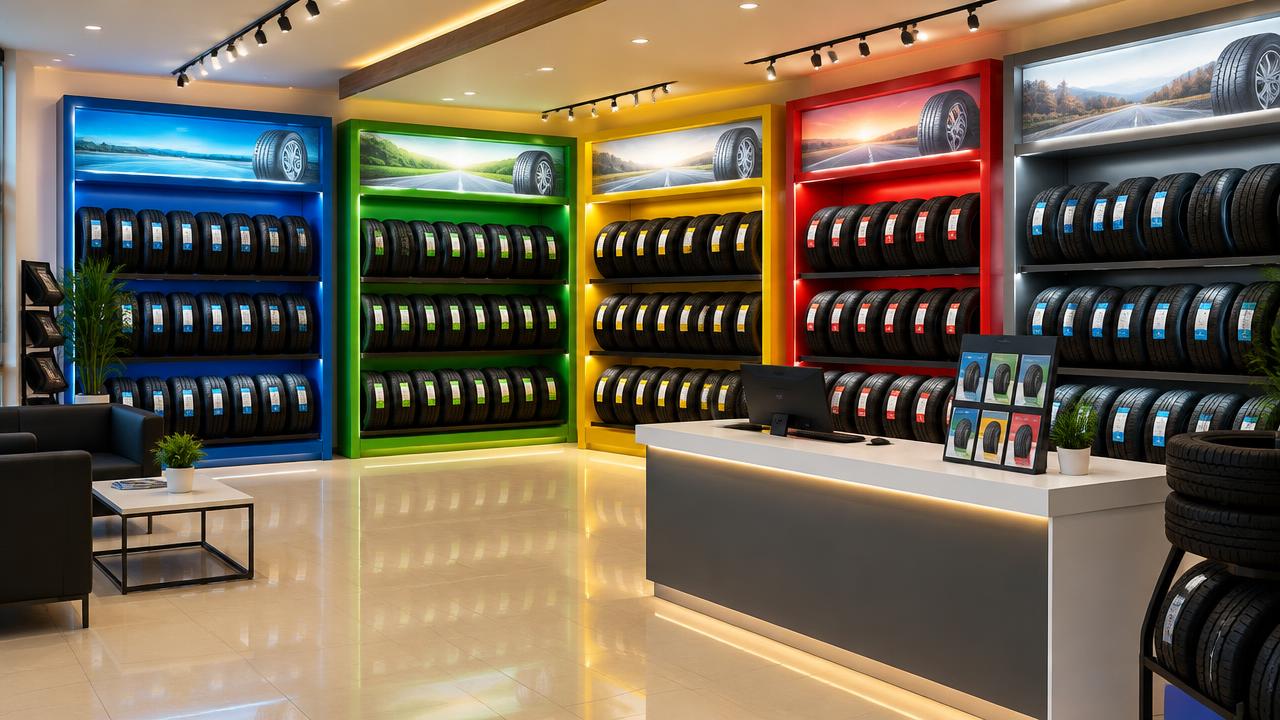
- Branded counter front: a printed or backlit panel facing the customer
- Brochure holder: for customers who want to take details home
Designing comparison cards that dealers will use
The comparison card is often the most useful counter tool. It should show a small number of options side by side, with the same structure for each: range name, intended use, and three or four benefits in plain language. Icons can help, but they should reflect the manufacturer's approved product information rather than vague marketing claims.
Make the card easy to read across the counter. Customers will be viewing it upside down or at an angle, so a slanted acrylic holder or a double-sided stand helps. Keep pricing off the permanent card unless the manufacturer's policy allows it, since prices change and differ by dealer. A replaceable insert keeps the card current when ranges are updated.
Using samples and touch
Tyres are physical products, and customers often trust what they can feel. A small tread sample or a mounted cross-section placed on the counter helps the dealer show details such as tread depth, groove design or construction layers. It turns an abstract claim into something tangible.
Samples should be clean, securely mounted and clearly linked to the range they represent. A small label or base graphic helps avoid confusion. Where cross-sections are used, make sure edges are finished safely so customers can handle them.
The counter front and back wall
The counter front faces the customer throughout the conversation. A printed or backlit panel with brand colours and a simple message reinforces the brand without adding clutter. ACP or acrylic panels with LED backlighting look finished and are easy to clean.
The wall behind the counter is also prime space. Instead of random posters, consider a single branded graphic, a range overview or a tyre care message. Keep it calm and readable; the customer's attention should stay on the conversation and the counter tools, not on visual noise.
Keeping the counter clean and current
Counter branding loses value quickly when it becomes outdated or cluttered. Old scheme posters, faded cards and broken holders send the wrong message. Build simple maintenance into the programme: replaceable inserts, a clear schedule for updating offers and a short dealer checklist.
It helps to agree with dealers on what the counter should and should not hold. A small branded tray for paperwork or a drawer for billing items can keep the customer-facing surface clear. Dealers are more likely to keep the counter tidy when the branding makes their job easier rather than harder.
- Use replaceable inserts for offers and range changes
- Remove expired material promptly
- Provide space for dealer paperwork away from the customer side
- Check holders and samples for damage during routine visits
Rolling out counter branding across dealers
Countertop kits are relatively low cost compared with fascia or interior upgrades, which makes them a practical early step in a network programme. A standard kit with a few size variations can be manufactured centrally and dispatched to outlets with simple installation guidance.
Start with a pilot across around ten representative outlets to test which items dealers use and which get ignored. Collect dealer feedback, observe counter conversations where possible, and track indicators such as premium range enquiries and QR scans. Treat sales trends carefully, since schemes, stock and season also influence results.
Common countertop mistakes to avoid
The most frequent problem is clutter. When every supplier, scheme and local service places a sticker or standee on the counter, nothing stands out and the brand message is lost. A clear rule about what belongs on the customer-facing surface helps far more than adding another display.
A second mistake is designing counter material that only makes sense to the brand team. Dealers and customers need plain language, readable type and a format that supports a quick explanation. Material that is too technical, too small or too fragile is soon put away in a drawer. A third mistake is forgetting the dealer's workflow: billing machines, card terminals and job cards must still fit comfortably, so counter kits should be sized after measuring real counters during the survey.
- Too many competing items on the counter
- Technical language customers do not understand
- Fragile holders that break within weeks
- Kits that do not fit actual counter dimensions
How Sign Ad India can help
Sign Ad India supports in-shop branding with printing, fabrication and installation. For countertop programmes, this can include acrylic and ACP stands, CNC and laser-cut components, UV printing for cards and panels, backlit counter fronts, wall graphics and kit packing for dispatch to multiple outlets.
We can align counter kits with your fascia, display stands and wall graphics so the full outlet feels consistent. If you would like to improve the final moments of the tyre purchase across your dealers, we can prepare a dealer branding proposal or discuss a 10-outlet audit enquiry.
Frequently asked questions
What should a tyre counter display include?
A comparison card, a tread or cross-section sample, a QR standee and a replaceable offer insert are usually enough. A branded counter front adds consistency without cluttering the counter surface.
Should prices be shown on counter comparison cards?
Usually it is better to keep prices off permanent cards, since prices change and differ by dealer. Use replaceable inserts if price communication is allowed by the manufacturer's policy.
Is countertop branding suitable for small dealers?
Yes. Counter kits are compact and relatively low cost, making them practical for small outlets as well as larger showrooms.
How can we tell if counter branding is working?
Dealer feedback, observation of counter conversations, QR scans and premium range enquiries are useful indicators. Sales changes should be interpreted carefully alongside pricing, schemes and seasonal demand.
Strengthen the final moment of the tyre sale
Share your dealer count and range priorities, and we will prepare a dealer branding proposal for countertop kits or discuss a 10-outlet audit enquiry.